

The Central Administration of the Romanian Orthodox Church of America – Vatra Românească
Romanian Immigration and the Founding of the Episcopate
The first Romanian Orthodox faithful immigrated to North America at the end of the 19th century, settling mostly in the Great Lakes region. Many fled persecutions from Hungarian-Austrian authorities in the Romanian provinces of Transylvania and Bucovina.
In 1929, the local parishes formed a Deanery. By 1934, they had established a Diocese (Episcopate), and Bishop Policarp Morușca, the first bishop, arrived from Romania to lead the Church.

The Boland Estate: Grey Tower Farms
In search of a central site, members of the Detroit community purchased the Boland Farm in 1937 from the Chandler family for $25,000. They assumed two mortgages totaling approximately $14,500 and other costs. At that time, the buildings had a replacement value of $200,000.
The inauguration of the settlement of Vatra Românească in Grass Lake (Jackson), Michigan, took place on July 3-4 1938. His Grace Bishop Policarp, the first Romanian Orthodox Bishop in North America was joined by numerous clergy and thousands of faithful for the laying of the foundation of what would become the headquarters of the Romanian Orthodox Episcopate of America and a “home away from home” for Romanian Orthodox faithful in the new world.
Also taking place that weekend on July 4 was the founding Congress of “Asociația Reuniunilor Femeilor Ortodoxe Române din America de Nord” (The Association of Romanian Orthodox Ladies Auxiliaries of North America) – ARFORA, the women’s organization that to this day brings together women through their parish ladies auxiliaries to support the work and mission of the ROEA, as well as other charitable and spiritual activities.

Historical Background
Originally home to Ottawa and Chippewa tribes, the land was later settled by the Boland family, who arrived from Scotland in 1710. William H. Boland moved from Connecticut to Michigan via the Erie Canal, settling on an 80-acre land grant signed by President Andrew Jackson in 1835.
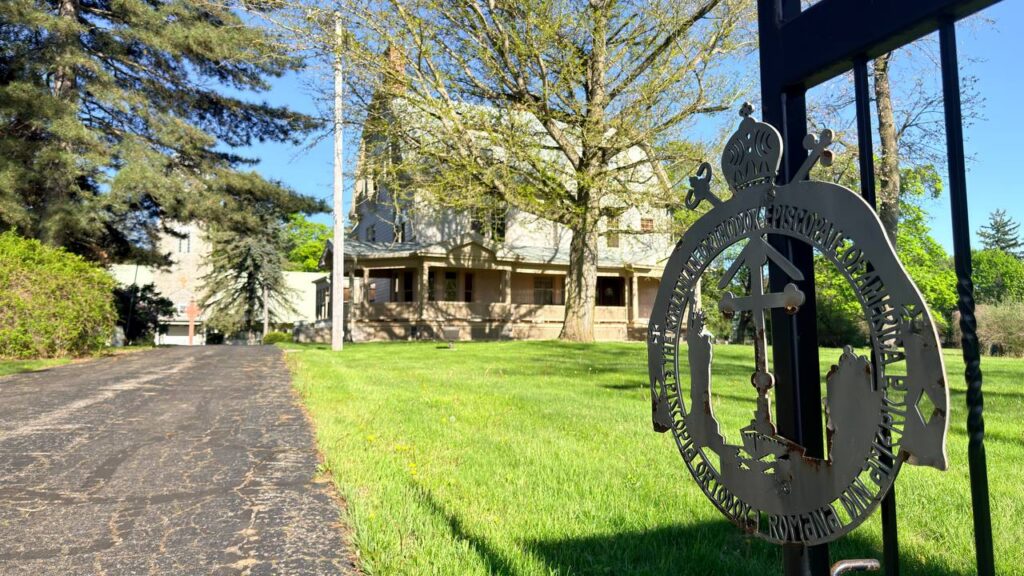
His son, William A. Boland, built the current mansion and expanded the estate to nearly 200 acres. Later generations lost interest in farming, and the property changed ownership twice before being purchased by the Romanian Episcopate. By then, many buildings were in poor condition and had to be demolished.
The letter “B” remains on the front door, which some now interpret as standing for “Bishop!”
Visiting the Buildings
The Main Residence – Bishop’s Residence (21 Rooms)
The house remains largely unaltered. It features:
- A spacious south side (former summer quarters)
- A smaller north side (servants’ quarters)
- Formal entryway with an arched doorway
- Parlor and dining room with beamed ceilings and working fireplaces
- Five fireplaces total
- Eight bedrooms
- Yellow oak woodwork with hand-crafted details
Stained-glass windows (not by Tiffany but still cherished) are found between the first and second floors and in a bathroom beneath the staircase.
The second floor, once housing church administrative offices until 1998, is under renovation and closed to the public.
The third floor contains four bedrooms. Two new bathrooms have been added.
Saint Mary Pioneer Chapel
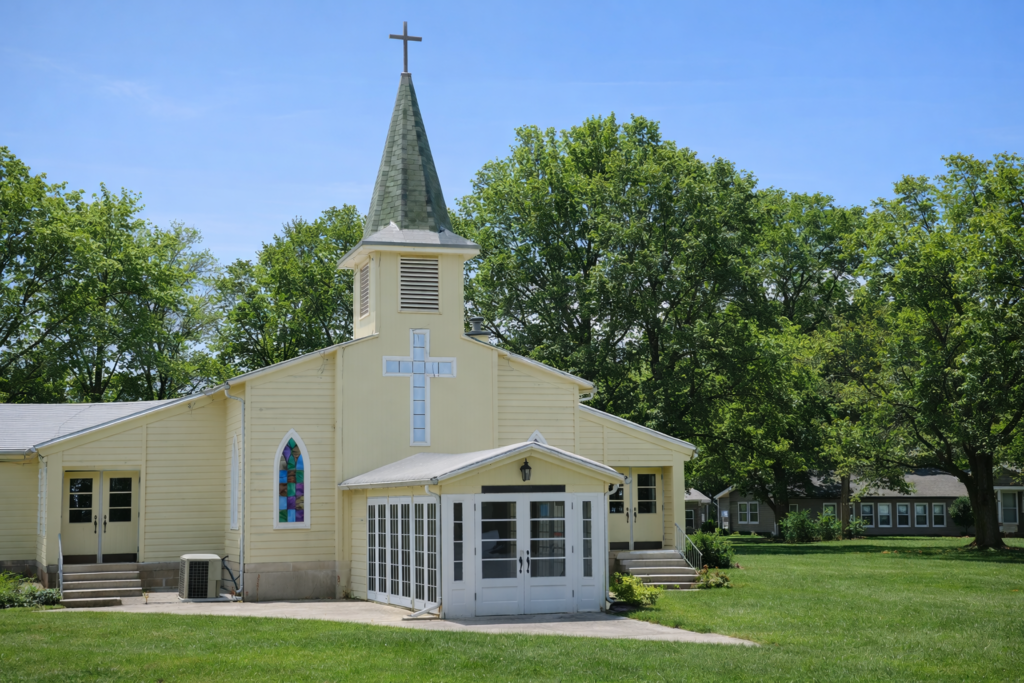
Originally intended as a large Romanian-style church, construction was halted due to lack of funds. By 1955, both a lower chapel and upper church were completed.
- Upper church: Used for the annual assembly and summer classes
- Lower chapel: Features a carved walnut icon screen separating the sanctuary from the nave
- Throne seal: Depicts a European church, a steamship heading to America with a cross, and the Statue of Liberty
- No pews, in keeping with Orthodox tradition
- Icons have recently been removed for restoration
Bell Tower (Former Water Tower)
Originally an 85-foot water tower with a 200-barrel tank, it now houses two large bells from a church in Weirton, West Virginia. This tower is one of the few remaining in Southern Michigan and is similar to towers in the Irish Hills area.
Other Buildings and Sites
- George Pomutz Hall: A barn now used for equipment storage. Named after a Romanian Brigadier General in the U.S. Civil War who later served as U.S. Consul to Russia.
- Avram Iancu Hall: Located in the former stable; now a summer kitchen, dining hall, and upstairs sleeping quarters for camp counselors. Named for the Romanian revolutionary of 1848.
- ARFORA House: Once caretaker’s quarters, now houses summer cooks and staff. ARFORA is the women’s auxiliary of the Episcopate.
- Saint Simeon Summer Dormitory: Accommodates 50 students and staff during summer camps, where children learn Bible, Church history, ethics, and Romanian folk traditions.
- Nursing House: This building is used during Vatra Camp and includes a first-aid room for the camp nurse. It also provides accommodations for the priests and their families who teach during the camp.
- The Romanian American Heritage Center: The Valerian D. Trifa Romanian American Heritage Center was the brainchild of the late Archbishop Valerian. His intention was to encourage cooperation between the numerous institutions, parishes, diocesan centers, and individuals of Romanian origin. The Center would be an independent corporate institution, a safe place where the official records, publications (newspapers, pamphlets, etc.), personal papers (documents and correspondence, etc.), and life stories of the Romanian immigrants and their descendants could be stored and documented.
Historical Quote:
“Moved into our house (log), though small and not yet completed, feel to rejoice that we have a home of our own. May our house ever be that of prayer and kindness, peace and happiness dwell herein. O, for wisdom from above to direct us in every duty which is incumbent upon us.” – Mrs. Boland’s diary, June 12, 1835:
